


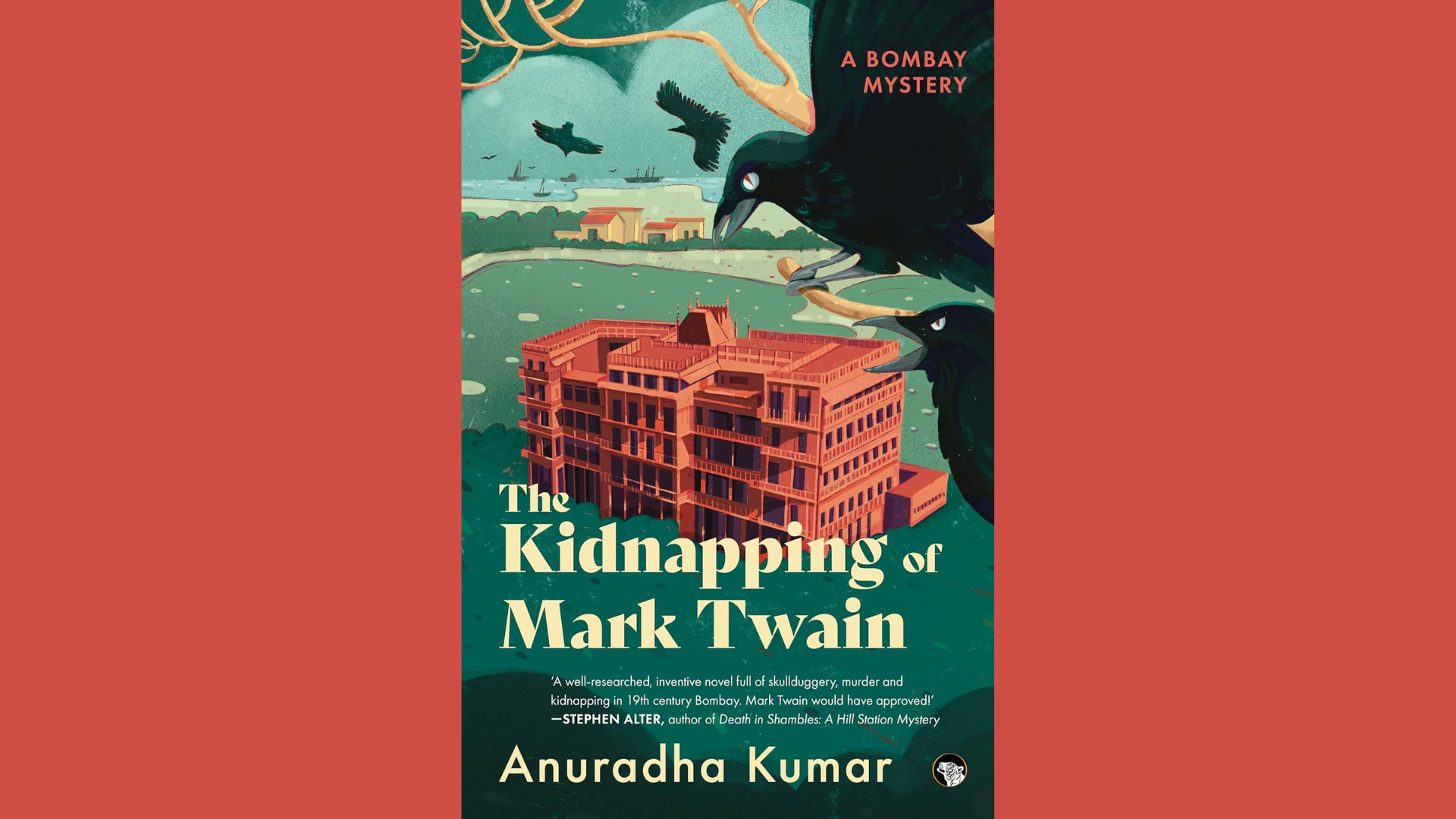
The Kidnapping of Mark Twain: A Bombay Mystery
by Anuradha Kumar
Published by Speaking Tiger (2023)
I have a particular soft spot for fiction that borrows real people from history and drops them into imagined escapades. So, I have to admit, I chose the book for its title and the enticing blurb at the back: “In 1896, Mark Twain arrives at the docks of Bombay, wife and daughter in tow, and… vanishes from his room… in the dead of night.” Perfect! A character as colourful as Mark Twain, set loose in colonial Bombay? I was strapped in, ready for takeoff.
Except this flight took its time taxiing on the runway. The idea of placing the acerbically observant Twain in colonial Bombay is a brilliant one. Unfortunately, he appears far too little, serving more as a plot device than a fully developed character. His voice, which we know so well from his writing, does not quite get a chance to emerge. Twain arrives with his wife and daughter in Chapter I, vanishes in the night, as promised, in Chapter V, only to return towards the end of the book (I’m not spoiling anything here; it was the kidnapping, not murder of Mark Twain). It is a missed opportunity, perhaps, because it doesn’t let Twain do what Twain does best: observe, comment, and provoke.
However, if you’re not a Twain-o-phile (that rare and stubborn species) but enjoy historical fiction, this book offers a refreshing break from the palace intrigues and royal dramas that often dominate Indian historical fiction. Anuradha Kumar knows her Bombay. There is real research at work here.
The artist M.V. Dhurandhar makes a cameo, as does John Lockwood Kipling (Rudyard Kipling’s father), and Oscar Wilde—well, not the man himself, but news of his legal troubles, rippling across the empire. Kumar even makes Manuel, Twain’s actual servant, whom he writes about in his 1897 travel memoir, Following the Equator, a fairly significant character.
Twain’s Manuel struggles to explain his European name to his employer in broken English. His father is Portuguese, and his mother is a Hindu Brahmin. Manuel, though himself impoverished and servile, was proud of his “pure” and elevated pedigree. So proud that he refused to clean Twain’s bathroom and ran off to find a ‘sudra’, as Twain explains, to do the job. This incident brought the author face to face with the Indian caste system. It was a subject he tore into in Following the Equator, curiously overlooking the equally absurd and entrenched caste system in his own land—racism.
Kumar walks us through a very vivid late nineteenth-century Bombay. You pass Watson’s Hotel, the Colaba Causeway, cotton mills, opium dens, and get to peep into colonial bungalows. In addition to Manuel, she draws from other real-life events like the murder of a young girl named Casi, unrest among cotton mill workers and the rise of evangelical temperance missionaries in Bombay. These are all marvellous details that would delight a history nerd like me, while also offering rich context for readers new to this period.
The story unfolds through the eyes of Henry Baker, the American consul in Bombay, and the mysterious Maya Barton, a clever and unconventional woman with a knack for getting herself in interesting situations. Henry has been tasked with hosting Mark Twain and his family during their visit, which draws him into the baffling mystery of the great author’s sudden disappearance. There are a number of colourful side characters, such as the magician and stilts enthusiast Bancroft, or a slimy temperance missionary, Arthur Pease.
As a reader of mysteries and a lover of those slow-burning ones where two attractive detectives solve crimes while trying to deal with their feelings, I appreciated the setup. I love a good whodunnit with an equally compelling will-they-won’t-they.
In practice, Henry’s admiration for Maya often eclipses her presence on the page, leaving us with a hazier sense of both characters than the setting around them. As a result, her character never quite comes into clear focus. This is frustrating because the city around them is buzzing with life. That said, Henry has a bit of golden-retriever energy. He is sweet, earnest, and eager to please. It’s the kind of charm one might find endearing in a real-life boyfriend, though in a literary narrator, I occasionally found myself wishing he’d stop swooning and start paying closer attention to the story happening around him.
The book moves at the pace of a thoughtful stroll, occasionally wandering into side plots or Henry’s reflections, even as events unfold around him. While there are moments of tension, the mystery develops more as a soft pulse rather than a racing heartbeat.
What kept me returning to this book every night was Kumar’s lovely command over language and its warm, cosy, and charming feel. Now and then, it hits just the right note. I especially enjoyed the little side characters who popped in and out of the scenes, like bits of tutti-frutti in a soft, familiar bun. Those unexpected bites of sweetness take you back to old-school bakery flavours and childhood afternoons. In the end, this is a cosy mystery that never quite catches fire, but then, perhaps it wasn’t trying to. It glows in patches, especially for those who enjoy atmosphere over action.




RELATED ARTICLESMORE FROM AUTHOR
Swallowing the Sun
Death of a Gentleman
Sinema: : The Bollywood Bungle of Andy Duggal