


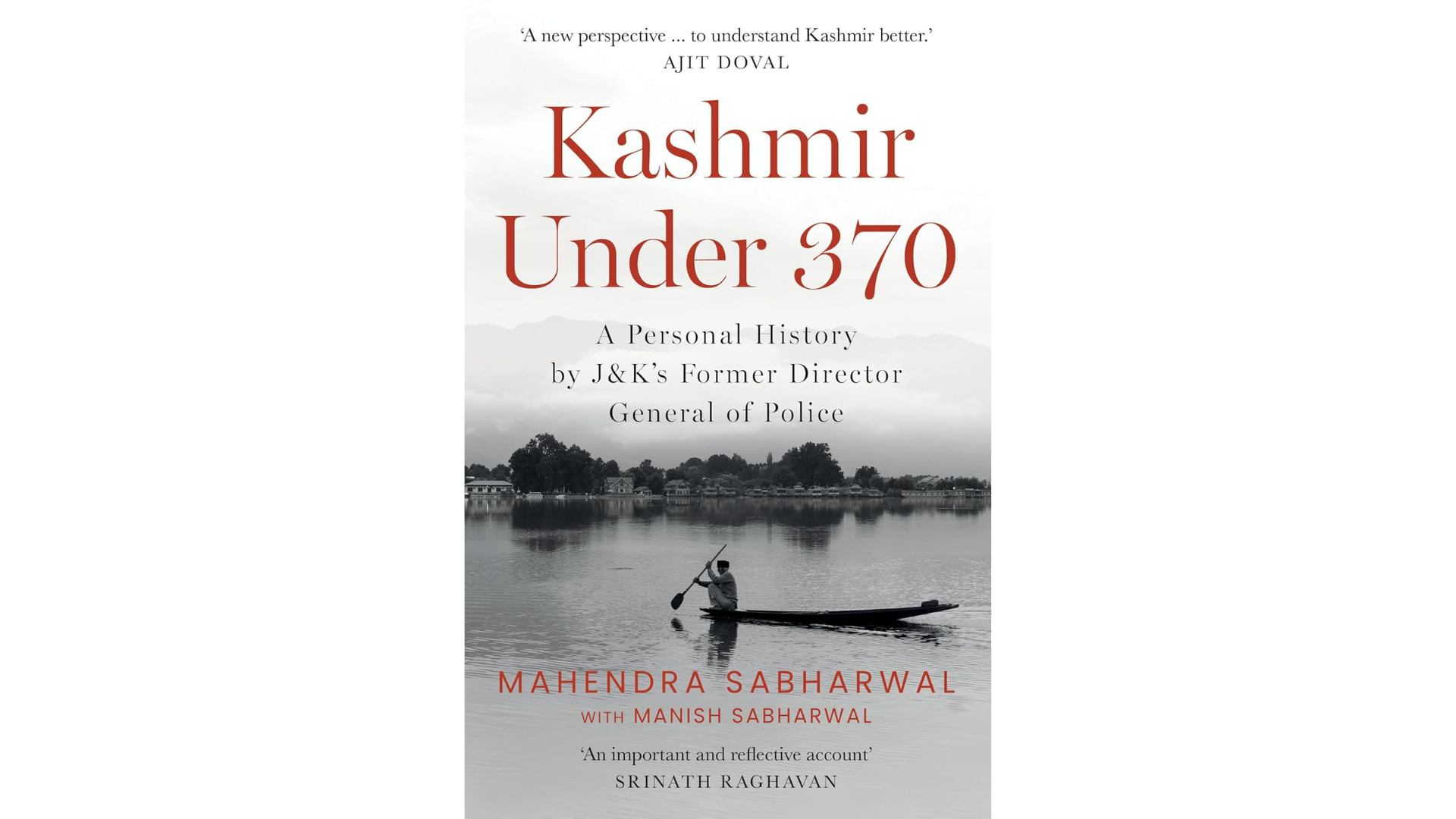
KASHMIR UNDER 370 : A Personal History by J&K’s Former Director General of Police
by Mahendra Sabharwal and Manish Sabharwal
Published by Juggernaut (2024)
The state of Jammu and Kashmir can be understood from two different lenses: one is made by keeping the administration as the core; whereas the other is maintained by those who want its freedom from India and Pakistan to become an independent nation. It is easy to comment on the politics and crisis of J&K by living in other parts of the country. But those who breathe the air of the state, taste the mud of its land, and bleed and sweat to keep the state in peace know the reality without any mixture. Writers like Mirza Waheed or Basharat Peer make us believe in the horrific condition of Kashmir under the army rule. They also speak about the dilemma of the young minds living in a state where both the government and liberators confiscate them for their own benefit.
To have a book that documents the socio-political climate of Jammu and Kashmir by keeping facts before the readers, with time has become accessible. To find a book written from the perspective of administration has also become easy. But what’s tough is to have a work of non-fiction where both the administration and the state are marinated in personal experiences. Kashmir Under 370: A Personal History by J&K’s Former Director General of Police by Mahendra Sabharwal with Manish Sabharwal is one such book where the personal is wedded to the political. The bond gives it the courage to be critical towards the political parties who garner votes in the name of Kashmir and also towards the revolutionary fronts who keep people in the delusion of some independence.
Understanding Kashmir, its demographics and politics from the eyes of politicians has never done justice to the place and its people. Every politician of any state arrives with an agenda to either control the place or to manipulate its citizens. This particular book, on the other hand, is written by a person who has spent more than thirty years in maintaining the law and order of the state whose security has been the crux of Indian administration. Mahendra Sabharwal has been in control of the security of the state since early 60s, and his vision of Kashmir is both objective and romantic, at the same time. His objective version presents before us a Kashmir in which various liberation fronts have been manipulating and terrorizing people of Kashmir to stand in favour of an independent Kashmir (which goes against India). From the siege of Hazratbal shrine to the development of sympathy towards the country and motive of Pakistan, Sabharwal keeps before us facts on how terrorists infiltrate and then force the Indian administration to move in their favour.
The romantic vision of Sabharwal divides Kashmir and its people into two separate communities: the first one glorifies the Sufi and peace-loving practice; and the second one is violent and adamant about its need to separate Kashmir from India. As someone in the position of security in-charge, he avoids the gray areas and hence, develops a binary vision. In the book, he criticizes every Governor and Prime Minister for the way they handle Jammu and Kashmir. Yet, in several cases, he fails to establish a strong opinion on his criticism. Like for example, he dislikes the fact that Jawaharlal Nehru took the crisis between Pakistan and J&K to the United Nations during the time of independence which placed the entire situation on an international platform. Little does he realize, that with a looted economy and a dismantled army, taking the issue before the UN was the solitary option. Along with this, the journalists of international media channels were already covering the crisis, so it had been on the international platforms irrespective of Nehru’s decision.
Any senior security personnel of India would favour the present government’s decision of abrogating Article 370. The general laws of Indian Penal Code do not become operational in the presence of this article and so, the security forces have to be given special permission to maintain law and order. Sabharwal, in this book, mentions the downfall of terrorist attacks after the abrogation of the article, but the data has something else to offer. Statistically, the number of terrorist attacks have increased in the valley, especially against the armed forces, which immediately puts a few big questions in our minds: were we wrong all the time about Article 370? How is the valley going to be in the upcoming ten years without this article? Did the government think about the culture, history and condition of the state before abrogating the article? J&K was given special status because its Maharaja did not even ask its own citizens before taking his decision on a princely state. Abrogating the article gave Pakistan an easy access to spill its propaganda inside the young minds.
But, at the same time, from the standpoint of security forces and police, the abrogation worked in their favour. When Sabharwal and his colleagues speak about reduction of militancy and separatist activities in Kashmir, the martyred soldiers speak the reality out loud. Yet, today the general laws are more active in the valley and it has reduced the number of innocent victims. But what about the actual demands of the Kashmiris? What about those half-widows who still wear the picture of their husbands around their neck only for the police to recognize them? At a time, where minorities from a particular religion are being cornered and lynched in various parts of the country, what is the government doing to make the Kashmiris feel safe? The entire propaganda that Pakistan has been feeding them from the time of independence is based on Islamic identity. After the abrogation of Article 370, since the air of India is already thick with hate, how is India dealing with a planned religious propaganda?
Kashmir Under 370: A Personal History by J&K’s Former Director General of Police is an important book to understand the impact of Article 370 from the perspective of security forces. Although it is written on the body of problems and has very little solutions to the major problems of the valley, the book offers us an idea of how terrorist activities operate in the valley. Readers may or may not agree with the writer’s opinions or statements, but they have substantial information about how most senior officers perceive politicians, their policies and perception about Jammu and Kashmir. A book written by a frustrated officer who could not buy a land in the valley due to Article 370, heavily relies on his personal experiences wherein he quotes everything to justify the article’s abrogation. Readers are going to find answers to many questions, but most of the answers have another side which no one should overlook. A book that reminds us of the bond between responsibility and power.



RELATED ARTICLESMORE FROM AUTHOR
The Book Of Everlasting Things
Chicanery
Of Oppressor’s Body & Mind