


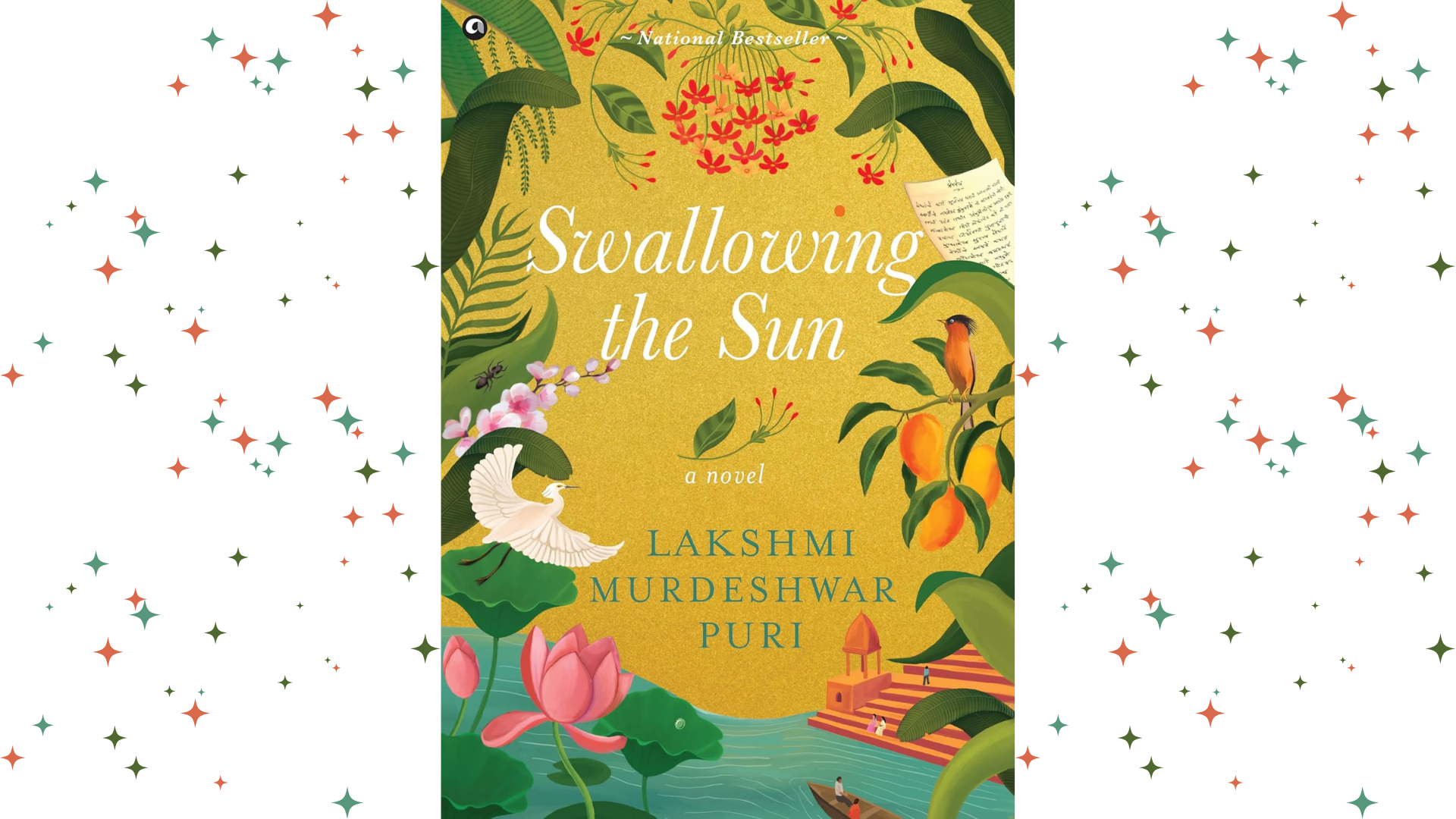
Swallowing the Sun
by Lakshmi Murdeshwar Puri
Published by Aleph (2024)
A story so colourful and culturally rich, you cannot help but sway with its rhythm.
While reading Swallowing the Sun by Lakshmi Murdeshwar Puri, you get to travel back in time, with the help of vivid imagery, folklores, descriptive passages, and stories from around the nation. This book truly feels like a carefully crafted work of art, subtly reflecting the experiences Lakshmi has had in her own life. Lakshmi herself was part of the United Nations for 15 years and served as an Indian diplomat for 28 years. She talks about how she draws her inspiration from the love letters she found of her parents; as weird as it sounds, it helps her build the narrative of the book with a world filled with love, purity, religion, and aspirations. From the first few pages, the book sets the stage with vivid descriptions and lyrical storytelling. Whether it’s the mango trees of Ratnagiri, the strict but loving routines of Ahilya Ashram, or the glittering chaos of Bombay, every place feels alive, almost like a character itself. You’re not just reading about these places; you’re walking through them with the characters. This isn’t just another freedom struggle story, it’s a deeply personal, almost musical journey of girlhood, curiosity, and change.
The story holds within it many characters, and each one has a depth and aura of its own. We mostly see different women throughout the story, but no two feel the same, each shine in their own light. Whether it’s Malati, our bold and curious protagonist, whose story takes center stage as the narrative progresses, or Kamala, who becomes a quieter shadow. Their elder sister Surekha, who becomes the queen of Vaishali and learns to be like their mother, and other women they meet along the way, each carry their own stories, struggles, and dreams. What stands out is how different each of these women are, not just in personality, but in the roles they play in the world they live in. No one feels like a background character; even minor figures like Hema Kaki with her soulful singing, or Sarala with her quiet acts of defiance, are given room to shine. However, later, the story focuses majorly on Malati and Guru’s adventures in love and life.
Lakshmi has done a beautiful job writing about a time in the past, the era of pre-independence, with a futuristic and radical lens. She forms a utopian world to live in that time where the girls study in co-ed schools, go on to college (the first in their family), and even take part in the nationalist movement. The story moves slowly, almost like it’s unfolding in real time, which makes it feel immersive, like you’re on the journey with them.
One of my favourite things about the book is how Lakshmi weaves in poems, songs, and music. Her inclusion of abhangs, devotional verse, Marathi ditties, plays like Satteche Gulam, and Bal Gandharva references infuse the novel’s musical cadence and push it beyond simple prose into a cultural symphony. At times, it almost feels like you’re reading a musical. She brings in references from Hindu mythology as well as from writers and thinkers like Freud, Nietzsche, and Savarkar, demonstrating the growth and learning of the two sisters. Their openness to understand the world and question things stands out clearly, and their character development feels natural and relatable. However, references to the many philosophers seem a bit exaggerated or forcefully put in to display Kamala’s love for philosophy. This also tries to paint a flawless picture of their characters; however, a little flaw would have felt more inclusive.
Lakshmi doesn’t shy away from showing the world the way it was, full of stereotypes and discrimination, but also shows how it was slowly opening to change. With not only female feminist characters but also men like Baba, Guru, and Vivek, who support them. These aren’t perfect men but evolve, sometimes reluctantly, toward empathy and dismantling patriarchy. There are characters who resist at first but gradually adapt, we see this within conversations the women have with each other or even when the narrator reveals the inner monologues of the characters. This makes reading the book feel hopeful, full of dreams, ideals, and quiet revolutions.
The title, Swallowing the Sun, is adapted from a verse by Muktabai, a 13th century saint from Maharashtra, the specific line where “the ant flies into the sky and swallows the sun”. Lakshmi includes a lot of religious ideologies and sentiments with supernatural elements, which makes it feel like reading almost a fantasy. It draws originally from a story in Hindu mythology, where Hanuman mistakes the sun for a fruit and leaps to swallow it. That idea of doing something unusual or unexpected, challenging the impenetrable and something scary like the sun becomes central to the entire story. The sisters constantly challenge stereotypes, old ideologies, and an orthodox mindset, slowly becoming the hero of their own story. The religious and philosophical undertones continue throughout, layered in with songs, verses, and cultural references.
The book subtly brings forth the trials of a nation in bondage and reveals the human side of the families who otherwise seem to be blessed with plenty. Above all, it is a story about the girls who dared to dream and how it started with Baba who helped them open their wings. Lakshmi Puri herself has had an incredible career, and you can feel her experience in the way she writes. She knows the weight of tradition and the strength it takes to move beyond it. Her writing doesn’t shout; it sings. And it tells us stories that matter.
If you’re looking for a fast-paced read full of twists and drama, this may not be the book for you. But if you want to sit with a story, let it breathe, take its time, and slowly wrap around your heart, Swallowing the Sun will stay with you. It’s a story about women who dreamt big, even when the world told them not to. And a gentle reminder that change doesn’t always begin with loud rebellion; sometimes, it starts quietly, in someone’s heart, in a classroom, or in a quiet moment under a mango tree.



RELATED ARTICLESMORE FROM AUTHOR
Death of a Gentleman
Sinema: : The Bollywood Bungle of Andy Duggal
Daiva: Discovering the Extraordinary World of Spirit Worship